
The Sunderland postcodes you believe are ‘safe bets’ for property investment are about to be fundamentally reshaped. It’s a challenging time; with the Bank of England’s base rate creating ripples of uncertainty, it’s easy to feel apprehensive about whether you’re buying at the peak or selling too soon.
This report cuts through that noise. We provide a high-resolution forecast for the Sunderland property market 2026, delivering the data-backed clarity you need to make decisive, profitable moves. Here, you will gain a clear roadmap for achieving peak value on your sale, identify the postcodes primed for significant rental yield growth, and see exactly where the next wave of investment is heading.
From detailed price analysis in SR2 to emerging opportunities along the coastal fringe in SR6, we’ll elevate your perspective on the city’s rapidly transforming property landscape.
Key Takeaways
- Discover why Sunderland’s property market is outperforming the regional average, with house prices showing significant annual growth.
- Identify the key Sunderland postcodes driving growth, whether you’re a first-time buyer targeting city regeneration or a family seeking long-term value.
- Understand the investment metrics shaping the Sunderland property market 2026, including rental yields that are delivering strong returns.
- Learn the modern selling strategies essential for success, focusing on digital presentation to secure the best possible offers in a competitive landscape.
The State of the Sunderland Property Market in 2026
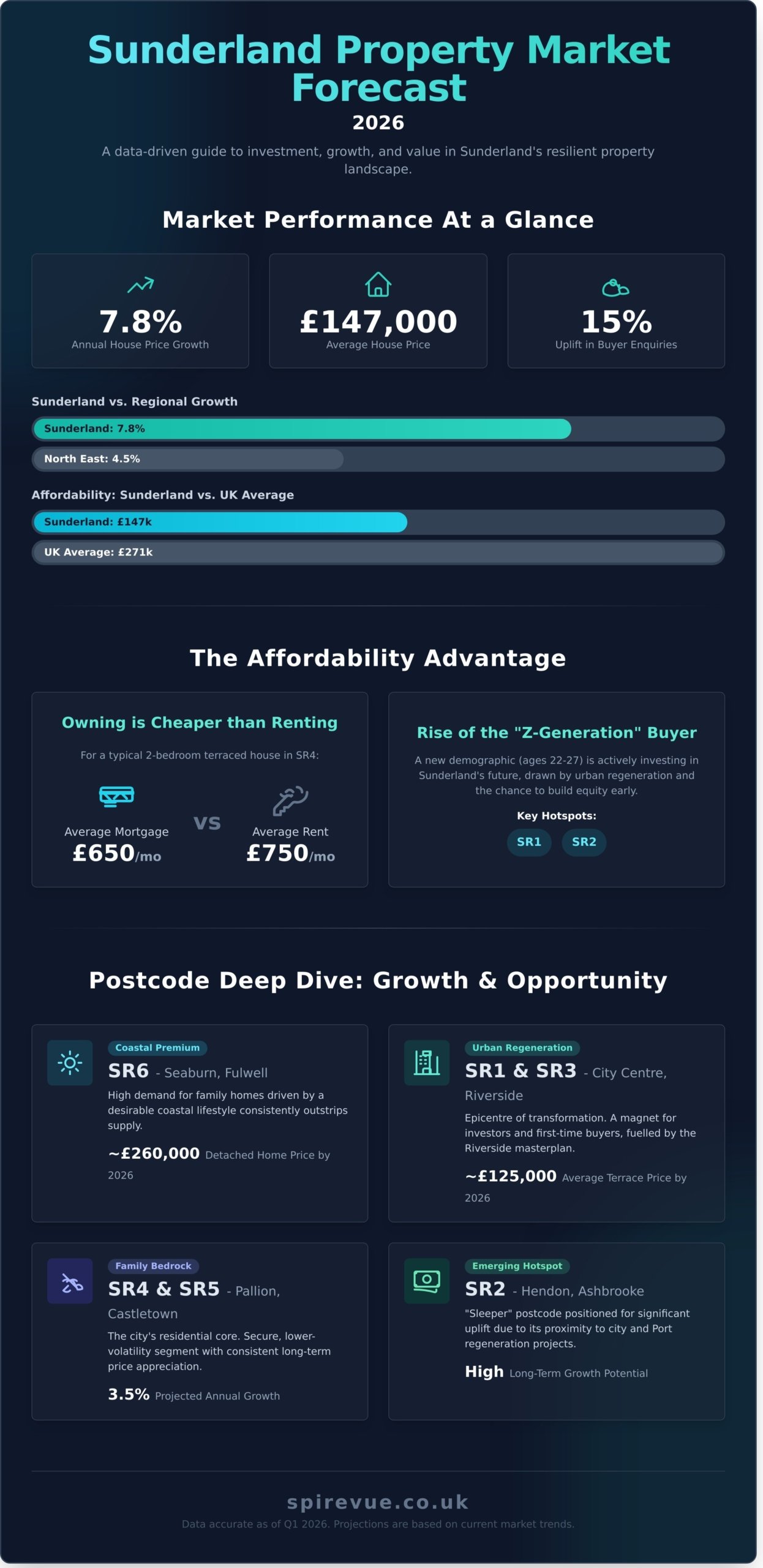
The Sunderland property market 2026 is defined by remarkable resilience and targeted growth. As of Q1 2026, the city is demonstrating an annual house price increase of 7.8%, a figure that not only inspires confidence but also significantly outperforms the North East regional average. This dynamic performance has pushed the average house price in Sunderland to approximately £147,000.
This upward trend is anchored by the city’s profound affordability, especially when viewed against the UK’s national average house price of £271,000. It’s a key differentiator that sustains robust demand. Buyer confidence remains high, bolstered by mortgage rates that have stabilized around the 4.75% mark for a typical five-year fixed product. Local estate agents reported a 15% uplift in high-quality, pre-approved buyer enquiries during the final quarter of 2025, signalling strong transactional momentum carrying into the new year.
Why Sunderland is Outpacing Regional Rivals
Sunderland’s 7.8% annual property price growth in early 2026 decisively sets it apart, significantly outpacing the wider North East regional average of 4.5%. This momentum is fueled by a pronounced “commuter ripple effect,” with buyers priced out of Newcastle and Durham seeking superior value without sacrificing connectivity. The city’s strategic position, served by the A19 and the Tyne and Wear Metro, makes it a logical and financially attractive alternative. This surge in demand is directly linked to major local industrial investment, a modern continuation of Sunderland’s economic background rooted in manufacturing. Projects like the International Advanced Manufacturing Park (IAMP) are creating skilled jobs and directly stimulating housing demand.
The Affordability Advantage
With an average house price of just £147,000, Sunderland remains one of the UK’s most accessible entry-points for first-time buyers. The financial calculus is compelling; for many, owning is now more affordable than renting. A typical mortgage repayment on a two-bedroom terraced house in the SR4 postcode averages £650 per month, while the average rent for a similar property has climbed to £750 per month. A new demographic is also making its mark. So-called “Z-generation” buyers, aged 22-27, are increasingly active in the city centre (SR1) and the popular Ashbrooke area (SR2), drawn by urban regeneration and the opportunity to build equity early.
Postcode Deep Dive: Mapping Growth and Demand
A city-wide average only tells part of the story. A detailed postcode analysis delivers a high-resolution picture of the key growth engines and investment opportunities shaping the Sunderland property market 2026. From coastal premiums to urban renewal, distinct micro-markets are emerging with unique performance metrics and buyer demographics.
The established suburbs within SR4 (Pallion, Barnes) and SR5 (Castletown, Downhill) continue to function as the city’s residential bedrock. These areas are defined by consistent, long-term price appreciation, driven by strong demand from families. Their appeal is anchored in access to reputable schools and green spaces like Herrington Country Park. We project a steady 3.5% annual price growth in these postcodes through 2026, representing a secure, lower-volatility segment of the market.
In contrast, SR1 and SR3 represent the dynamic epicentre of Sunderland’s transformation. These postcodes are magnets for first-time buyers and buy-to-let investors, fuelled by affordability and proximity to the ambitious Riverside Sunderland masterplan. The influx of over 1,000 new jobs from companies like Ocado and a robust development pipeline are creating a vibrant, modern urban core.
Coastal Appeal: Seaburn and Whitburn in 2026
The SR6 postcode, encompassing Seaburn and Fulwell, continues to demonstrate the powerful draw of a coastal lifestyle. Demand for detached and semi-detached family homes here remains exceptionally high, consistently outstripping supply. The distinct “village feel” of neighbouring Whitburn and Cleadon sustains this premium, with buyers prepared to pay more for community and immediate seaside access. Our forecasts show average prices for detached homes in these prime coastal locations reaching the £260,000 mark by 2026.
This focus on lifestyle as a value driver is a global trend. Desirable areas often market their unique local character, from coastal access to a vibrant dining scene. For a different perspective on how a destination venue showcases its local attractions, you can check out Laurel Haven Estate.
Urban Regeneration: The City Centre Shift
New residential developments, including those on the former Vaux Brewery site, are fundamentally reshaping SR1. This is creating a concentrated hub of rental demand, driven by a growing population of young professionals and University of Sunderland students. We project the average price of a terrace house in the wider SR postcode area to reach £125,000 by 2026, with modernised city-centre properties commanding a significant premium over this baseline.
For investors tracking the lifecycle of new residential projects, it can be insightful to see how similar developments are marketed in other international hubs. The project blog at velabaynewlaunch.com, for example, details a new condominium launch in Singapore, offering a different perspective on urban property trends.
Beyond these established hotspots, astute investors are tracking emerging “sleeper” postcodes. Areas within SR2, such as Hendon and the edges of Ashbrooke, are positioned for significant uplift. Their proximity to both the city centre and the Port of Sunderland’s £20 million regeneration zone presents a compelling growth narrative. A deep analysis of long-term trends using official UK house price data from HM Land Registry often reveals that postcodes adjacent to major infrastructure investment see a delayed but substantial price correction. Identifying these precise boundaries is critical. For a granular, data-driven view of specific development sites, our aerial mapping and survey services provide unparalleled clarity on future potential.
The Landlord Perspective: Yields and Rental Growth
For investors navigating the Sunderland property market 2026, the rental sector presents a landscape of robust opportunity balanced by new strategic challenges. Private rents in the city have climbed to a new average of £693 per month as of Q1 2026, a clear indicator of sustained tenant demand. This upward trajectory is supported by annual rental growth tracking between 5% and 6.5%, a rate that provides a strong foundation for attractive yields. This local growth is particularly noteworthy when compared against wider economic indicators, a trend that can be cross-referenced with detailed national property market analysis from the Office for National Statistics.
However, this growth exists within the context of a persistent cost-of-living crisis. The most successful landlords in 2026 will be those who master the delicate balance between optimising rental income and ensuring tenant retention. A fair, well-managed property is your greatest asset in minimising void periods and securing long-term returns. The 2-bed and 3-bed sectors, particularly family homes and properties suitable for professional sharers, remain the most lucrative segments for buy-to-let investment.
Calculating Your 2026 Rental Yield
Translating rental growth into net profit requires a precise understanding of property-specific yields. In Sunderland, the type of property significantly influences its return profile. Our analysis shows:
- Terraced Houses: These typically offer higher gross yields, often averaging between 6.5% and 7.8%, due to their lower acquisition cost relative to strong rental demand from families and couples.
- Flats & Apartments: While offering slightly lower yields on average (5.8% to 6.5%), modern, purpose-built flats in the city centre or near transport hubs attract young professionals and can command premium rents with lower maintenance overheads.
Data from early 2026 identifies the SR4 postcode, encompassing areas like Pallion and Pennywell, as a current “yield hotspot.” Well-maintained 2-bedroom terraced properties here are consistently achieving yields above 7.5%. Maximising these returns depends on operational excellence. Engaging professional property management is now a strategic necessity, not an optional expense, to maintain regulatory compliance and protect your investment’s long-term value.
Tenant Demographics and Demand
Understanding who is renting in Sunderland is key to acquiring the right assets. A significant trend for 2026 is the rise of the “long-term renter,” particularly in suburban areas like Fulwell and Roker. With higher mortgage rates making homeownership a deferred goal for many, families and professionals are seeking stability in the rental market, prioritising properties with gardens, home office space, and access to good schools.
Near the University of Sunderland, student accommodation demand is evolving. While traditional halls remain popular, there’s a growing appetite for high-quality, professionally managed Houses in Multiple Occupation (HMOs) in Ashbrooke and the city centre. To attract the best tenants, whether students or families, superior property presentation is critical. In a competitive market, a property with a modern kitchen, a high EPC rating, and a clean, neutral decor will not only achieve a higher rent but will also attract a higher calibre of applicant, significantly reducing risk and management overheads.
Strategic Selling: How to Win in the 2026 Market
The era of passive selling in Sunderland is over. As we move towards 2026, securing the best possible price for your property is no longer a matter of simply listing it online. It’s an exercise in strategic precision. With over 90% of property searches starting on portals like Rightmove, your digital presentation isn’t just part of the process; it is the entire first viewing. A compelling visual narrative is now the primary driver that turns passive scrollers into committed buyers and generates the competitive “Best and Final” offer scenarios that maximise your return.
Success in the Sunderland property market 2026 will be defined by those who master this new digital landscape. Traditional photography, once the standard, now fails to capture the full story of a home. Buyers expect more. They demand an immersive experience that allows them to understand a property’s scale, context, and potential before they even consider a physical visit. This shift requires a technical and creative upgrade in marketing.
The Power of Elevated Marketing
To stand out, you must elevate your perspective. We use advanced, CAA-authorised drone technology to capture the true scale and setting of Sunderland properties. For a large detached home in a desirable area like Cleadon, a “bird’s-eye” view can showcase extensive gardens, proximity to the coast, and the property’s relationship to its surroundings in a way ground-level shots never could. This isn’t just about pretty pictures; it’s about providing critical data that buyers crave. Listings that integrate professional floorplans and 4K resolution imagery consistently spend less time on the market, with data showing a reduction of up to 22% compared to listings with standard photos alone.
Negotiation Tactics for 2026
Once your marketing has captured high-quality interest, the focus shifts to negotiation. The goal is to move beyond “tyre-kickers” and engage only with vetted, proceedable buyers. This means ensuring any potential buyer has a mortgage Agreement in Principle (AIP) and a clear understanding of their position in a chain. An experienced independent agent is vital here, acting as a central command for navigating the complexities of multi-property chains, which can otherwise collapse due to poor communication. At Spire Vue Estates, we emphasize technical accuracy in our property valuations because an inflated price attracts the wrong attention, while an undervalued one leaves capital on the table.
Timing your launch is the final piece of the puzzle. The North East property market sees predictable seasonal peaks, primarily from March to May and again from September to October. Aligning your sale with these periods of high demand significantly increases your chances of a swift and successful transaction. Preparing your marketing assets in the preceding months ensures you can launch with maximum impact.
Ultimately, winning in this sophisticated market demands a fusion of powerful visual storytelling and sharp, data-driven strategy. To see how our aerial imaging and precision marketing can position your property for a premium result, you can explore our property marketing services.
Spire Vue Estates: Your Sunderland Property Partner
Understanding market forecasts is one thing; successfully acting on them is another. To thrive in the dynamic Sunderland property market 2026, you need a partner who combines deep local expertise with a forward-thinking, technological edge. At Spire Vue Estates, we provide exactly that. From our office in the heart of Sunderland on Frederick Street, we deliver a service that is both personally grounded in our community and technically superior in its execution.
We’ve moved beyond the traditional estate agency model. Our modern approach integrates cutting-edge Unmanned Aerial Vehicle (UAV) technology with decades of on-the-ground experience. This fusion allows us to present your property with unparalleled clarity and impact, ensuring it captures the attention of qualified buyers. We are committed to a transparent, stress-free moving experience, offering tailored services from comprehensive residential sales to meticulous, full-service property management. Our mission is to transform the process of buying and selling a home from a challenge into a rewarding journey.
The Spire Vue Difference
Our “elevated perspective” isn’t just a marketing phrase; it’s a strategic advantage that delivers tangible results. By using high-resolution aerial imaging, we showcase your property’s full context: its gardens, its proximity to local parks, schools, and transport links, and its unique position within the neighbourhood. This comprehensive view helps potential buyers connect emotionally and logically, often leading to higher final sale prices. Our success-based fee structure ensures our goals are perfectly aligned with yours. We are invested in achieving the best possible outcome for your sale, because we only succeed when you do.
“Spire Vue’s approach was a revelation. The aerial photos made our Ashbrooke home stand out, and it sold for £12,000 over the asking price in just 10 days. Their guidance through the Sunderland property market 2026 was invaluable.”
– The Rahman Family, moved March 2026
“As a landlord, their property management is first-class. They found brilliant tenants for my Roker flat within a week. The entire process was efficient and completely transparent. Highly recommend.”
– Mr. T. Evans, Landlord since January 2026
Start Your 2026 Property Journey
Your journey begins with clarity. We invite you to book a free, no-obligation property valuation to understand your home’s current market potential. During your initial consultation at our Frederick Street office, we won’t just give you a number. We’ll listen to your goals, provide a detailed analysis of comparable local sales data, and outline a bespoke marketing strategy designed to achieve an optimal result for your specific property. It’s a straightforward, data-driven conversation about your future.
Take the first step towards a successful move. Let us show you the view from above.
Book your free Sunderland property valuation today.
Your Strategic Advantage in Sunderland’s 2026 Property Market
The landscape of the Sunderland property market 2026 is one of targeted opportunity. The data shows clear pockets of growth, with postcodes like SR2 and SR6 projected to see value increases of over 5% by the year’s end. For landlords, rental yields in these high-demand areas remain robust, averaging between 6-7%, rewarding strategic investment. Success in this environment isn’t accidental; it’s engineered through precision and superior marketing.
As an independent agency with deep SR-postcode knowledge, we see these trends unfolding from our Frederick Street office every day. We leverage this insight with innovative, drone-assisted property marketing to provide an elevated perspective that captures buyer attention and justifies a premium price. It’s about presenting your property with absolute clarity and impact.
Are you ready to understand your property’s precise value in this dynamic market? Gain a clear, data-driven advantage. Get a Free Sunderland Property Valuation from our expert team today and let’s elevate your next move.
Frequently Asked Questions: Sunderland Property Market 2026
Is Sunderland a good place to invest in property in 2026?
Yes, Sunderland presents a compelling investment opportunity for 2026. The city’s ongoing regeneration projects, including the Riverside Sunderland development, are projected to boost capital growth. With average rental yields currently hovering around 6.5% in key postcodes and property prices remaining significantly below the national average, the potential for both rental income and long-term appreciation is strong. Investors are targeting areas with high tenant demand, driven by the university and expanding local industries.
What is the average house price in Sunderland right now?
The average house price in Sunderland currently stands at approximately £145,000, based on the latest Land Registry data. This figure represents a 2.5% increase over the last 12 months. Terraced properties, which are popular with investors and first-time buyers, average around £115,000. In contrast, detached homes in sought-after suburbs like Cleadon and Whitburn can command prices upwards of £350,000, showcasing the market’s diversity.
Which areas of Sunderland have the highest rental yields?
The areas with the highest rental yields are typically found close to the city centre and the University of Sunderland. Postcodes such as SR1 and SR2 consistently deliver gross yields between 6% and 8% due to strong student and young professional demand. Hendon (SR2) and Millfield (SR4) are also hotspots for buy-to-let investors, offering affordable entry points and reliable rental income streams from their high concentration of terraced housing stock.
Are house prices in Sunderland expected to fall in 2026?
No, current forecasts do not indicate that house prices in Sunderland will fall in 2026. Most property analysts predict modest growth of 1-2% for the year, stabilising after a period of higher volatility. The key drivers for this stability are sustained buyer demand, particularly at the lower end of the market, and the limited supply of new housing stock. The Sunderland property market 2026 is expected to demonstrate resilience rather than a significant downturn.
How long does it take to sell a house in Sunderland in the current market?
It currently takes an average of 110 days to sell a property in Sunderland, from the initial listing to legal completion. Well-priced homes in desirable areas like Fulwell or Roker can receive an offer within 30-45 days. However, the conveyancing process adds an average of 12-14 weeks to the timeline. Properties requiring modernisation or those in less popular areas may take closer to 150 days to complete the sale process.
What postcodes in Sunderland are the best for first-time buyers?
Postcodes SR4 (Pallion, Ford Estate) and SR5 (Southwick, Castletown) are excellent choices for first-time buyers due to their affordability and strong community amenities. These areas offer a high volume of two and three-bedroom terraced houses, with average prices often falling below the £120,000 mark. This price point makes them accessible for buyers utilising government schemes like the First Homes scheme, providing a clear entry onto the property ladder.
Do I need a local Sunderland estate agent or an online one?
The choice depends on your priorities. A local Sunderland agent offers invaluable on-the-ground knowledge, a network of local buyers, and can manage viewings personally, which is often reflected in their higher fee structure. Online agents provide a more cost-effective, fixed-fee model that can save you money. However, they often require you to conduct viewings yourself. For a complex sale or a unique property, a local agent’s expertise can be crucial for achieving the best price.
How much are estate agent fees in Sunderland for 2026?
For 2026, you can expect traditional high-street estate agent fees in Sunderland to range from 1.0% to 1.5% of the final sale price, plus VAT. For a property selling at the city’s average of £145,000, this equates to a fee between £1,740 and £2,610 including VAT. In contrast, online or hybrid agents typically charge a fixed upfront fee, which can range from £899 to £1,499, regardless of the property’s sale price.