
With private rental prices in the North East rising by 5.8% in the 12 months to February 2024, the search for stability has never been more critical. It’s a challenging market, often defined by unpredictable rent hikes, unresponsive landlords, and the looming uncertainty of the 2026 rental reforms. You aren’t just looking for a property; you’re seeking a secure, well-maintained foundation for your future in a desirable Sunderland postcode.
This guide delivers a clear, strategic perspective on the local market. We will equip you with the precise knowledge needed to secure a high-quality, compliant long term rental that offers both predictable monthly outgoings and genuine peace of mind. From decoding the specifics of an Assured Shorthold Tenancy to identifying landlords who meet rigorous standards, we’ll detail the exact steps to transform your property search from a source of anxiety into a calculated success.
Key Takeaways
- Master the essential compliance checks for 2026, ensuring any Sunderland property meets non-negotiable safety standards, including Gas Safety, EICR, and EPC.
- Discover the strategic financial and social benefits of securing a long term rental, providing stability against Sunderland’s dynamic market rates.
- Pinpoint the ideal Sunderland neighbourhood for your lifestyle, from the Victorian charm of Ashbrooke to the coastal appeal of Seaburn and Roker.
- Position yourself as the ideal tenant by preparing your ‘Right to Rent’ documentation and financial references ahead of your property search.
Defining Long Term Rental in the Sunderland Property Market
In the evolving Sunderland property market of 2026, a long term rental is defined not merely by contract duration but by a commitment to residential stability. The landscape has decisively shifted from transient lets towards a ‘Forever Rental’ model. This change reflects a tenant base seeking to establish genuine homes, driven by the region’s economic strength and enhanced tenancy security. While short-term and holiday lets serve a distinct, temporary accommodation need across Tyne and Wear, they operate under entirely different regulatory frameworks. For residential landlords, the focus is now on sustained, compliant tenancies, with initial contract terms of 12 to 24 months becoming the local standard, providing both landlord and tenant with predictable security.
The Assured Shorthold Tenancy (AST) in 2026
The Assured Shorthold Tenancy (AST) is the legal foundation delivering rental security and defining landlord-tenant obligations across the UK. By 2026, following the full implementation of rental reforms, the AST used by Sunderland agents is a refined, robust document. Key components now include:
- Deposit Protection Confirmation: Evidence of deposit registration with one of the three government-backed schemes (TDS, DPS, or MyDeposits) within 30 days of receipt.
- Regulated Rent Review Clauses: Clear, compliant terms outlining how and when rent can be reviewed, preventing unpredictable increases.
- Comprehensive ‘Right to Rent’ Checks: Documented proof of compliance with Home Office immigration status checks conducted before the tenancy begins.
Understanding the tenancy structure is critical. The reforms have largely phased out initial fixed-term contracts for new lets. Instead, tenancies now operate on a periodic basis from the start, rolling month-to-month. This provides tenants with flexibility, but landlords retain strong, legally defined grounds for possession, ensuring protection for their assets.
Why Sunderland is a Hub for Long-Term Renters
Sunderland’s appeal for long-term tenants is anchored in clear economic and strategic planning. The sustained impact of major local employers provides a consistent demand for high-quality housing. Nissan’s £2 billion EV36Zero gigafactory project, fully operational by 2026, and the University of Sunderland, which supports thousands of staff and postgraduate students, create a deep pool of professionals seeking stable, multi-year accommodation. This isn’t a temporary workforce; it’s a community putting down roots.
The growth of these major employers, and the wider business community they support, often relies on strategic human resources management, with many turning to expert consultancies such as Pioneer HR to support their expanding teams.
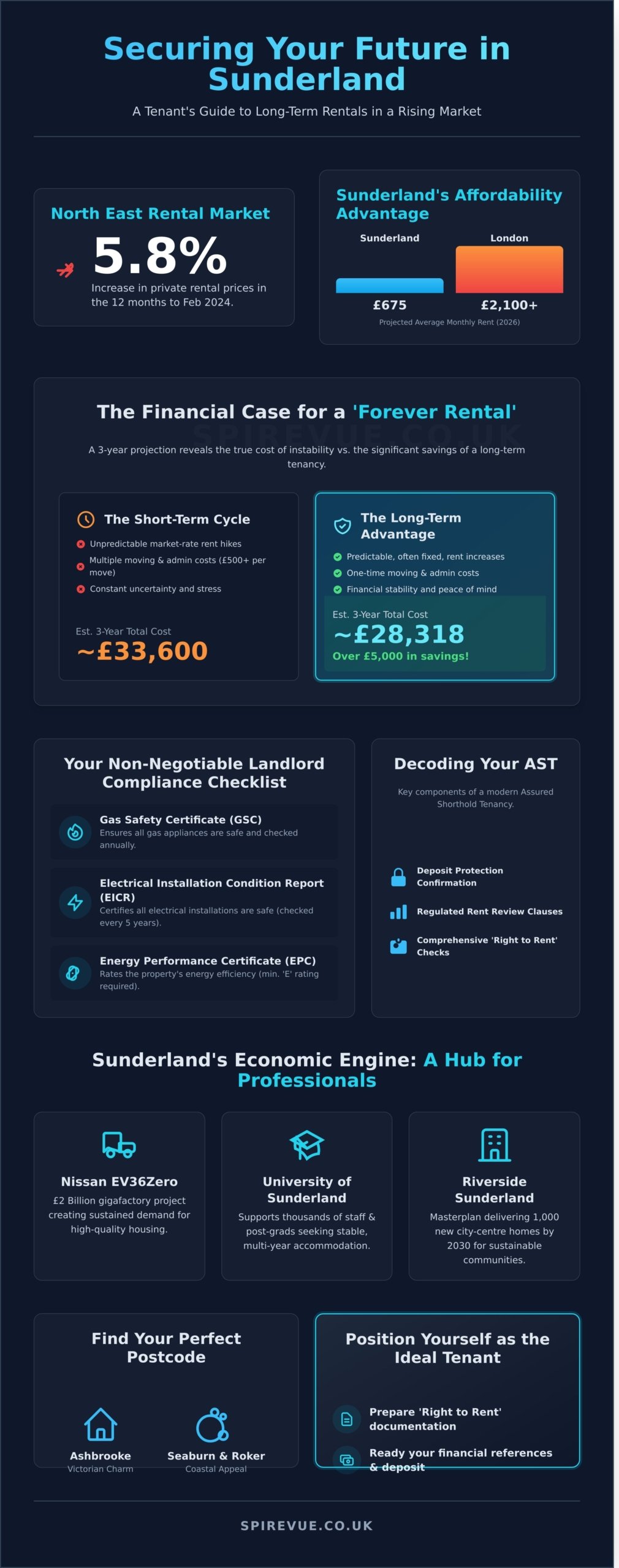
This demographic trend is directly supported by Sunderland City Council’s housing strategy. The ongoing Riverside Sunderland masterplan, which aims to deliver 1,000 new city-centre homes by 2030, is designed to create sustainable urban communities, not just housing units. This focus on long-term residential development makes the city increasingly attractive. Economically, the North East’s affordability remains a powerful draw. With average private rents projected to be around £675 per month in 2026, compared to over £2,100 in London, tenants have significantly more disposable income, making a high-quality long term rental a financially viable and attractive option for years, not just months.
The Strategic Benefits of Choosing a Long-Term Tenancy
In Sunderland’s dynamic property market, securing a tenancy is more than a transaction; it’s a strategic decision. While short-term lets offer flexibility, a long term rental provides a foundation for financial precision and personal stability. Opting for an extended tenancy transforms a property from a temporary base into a genuine home, unlocking benefits that short-term agreements simply cannot deliver. This approach allows tenants to integrate into a community, personalize their living space, and achieve a level of security that mitigates the stresses of the rental cycle.
Financial Stability and Rent Forecasting
A primary advantage of a long-term tenancy is the capacity for precise financial planning. Many multi-year agreements include pre-agreed rent review clauses, fixing annual increases to a specific figure, such as 3%, or linking them to the Retail Price Index (RPI). This transparency removes the uncertainty of unpredictable market-rate hikes common with shorter contracts. Consider the cost differential over three years:
- Scenario A: Three 6-Month Moves (18 months total)
- Initial Rent: £750/month
- Moving & Admin Costs (x3): est. £1,500 (£500 per move)
- Potential Rent Increases: Two reviews, potentially rising to £820/month by the third tenancy.
- Total Cost (18 months): £15,020
- Scenario B: One 3-Year Tenancy
- Initial Rent: £750/month
- Moving & Admin Costs (x1): est. £500
- Fixed Annual Increase: 3% per year.
- Total Cost (36 months): £28,454 (or £14,227 per 18 months)
The long-term option not only delivers an estimated saving of £793 over an 18-month period but also eliminates significant administrative burdens. This stability extends to budgeting for utilities and Sunderland City Council tax (for example, approximately £1,652 annually for a Band B property in 2024), making household financial forecasting far more accurate.
Psychological and Social Security
Residential stability provides profound psychological and social benefits. For families, staying in one location is critical for securing placements in sought-after local schools, avoiding the disruption that frequent moves can cause to a child’s education and social development. It allows you to build genuine roots in a Sunderland neighbourhood, whether it’s the community feel of Ashbrooke or the coastal appeal of Roker. You develop relationships with local business owners, become a regular at the corner café, and build a trusted network of neighbours.
This sense of permanence directly reduces ‘moving anxiety’-the cyclical stress of searching for properties, packing, and adapting to new environments. Knowing your rights and responsibilities is also key to this peace of mind. The UK government’s guide to private renting provides an essential, authoritative framework for tenants, clarifying the legal landscape and empowering you to manage your tenancy with confidence. This security is the defining feature of a successful long term rental. By choosing stability, you’re not just renting a space; you’re investing in a higher quality of life. To gain a clearer perspective on your tenancy strategy, it’s vital to weigh these non-financial returns alongside the clear economic advantages.
Navigating Rental Regulations and Compliance in Tyne and Wear
In 2026, the benchmark for a quality rental property in Sunderland isn’t just its location or aesthetics; it’s a rigorous adherence to safety and legal standards. This is the Spire Vue standard: a commitment where compliance isn’t a box-ticking exercise but the fundamental framework for a secure tenancy. For landlords, navigating this landscape is complex. For tenants, understanding these requirements is your first line of defence in securing a safe and professionally managed home.
This complexity isn’t just regulatory; it’s financial. Landlords are essentially running a business, needing to manage tax obligations and optimize their investment returns. While based in Dubai, specialist firms like Reflechir Consultancy provide a clear example of the professional accounting support property investors use to navigate these challenges successfully.
The foundation of a compliant property rests on three essential safety certifications. A failure to provide these isn’t just a minor oversight; it renders a tenancy agreement vulnerable and can invalidate eviction notices. These non-negotiable documents include:
- Gas Safety Certificate (CP12): An annual inspection conducted by a Gas Safe registered engineer, confirming all gas appliances, pipes, and flues are safe for use.
- Electrical Installation Condition Report (EICR): Required at least every five years, this report certifies that all fixed electrical installations in the property meet UK safety standards.
- Energy Performance Certificate (EPC): This certificate rates the property’s energy efficiency from A (most efficient) to G (least efficient) and is valid for 10 years.
Beyond the property itself, landlords have a legal duty to perform ‘Right to Rent’ checks. This process involves verifying that all adult tenants have the legal right to reside in the UK before the tenancy begins. These checks are a mandatory part of establishing a new tenancy and are detailed within the official government renting guide provided to tenants. A professional management service executes these checks with precision, protecting both landlord and tenant from significant penalties. This meticulous approach also prevents illegal eviction practices. By ensuring every piece of paperwork is correctly issued from day one, a professional manager validates the entire tenancy, making any future legal proceedings transparent and fair.
Technical Standards for Sunderland Homes
Current Minimum Energy Efficiency Standards (MEES) mandate that any property let on a new tenancy must have an EPC rating of ‘E’ or above. This directly impacts your heating bills, as a higher-rated home is cheaper to run. For tenants in Sunderland’s multi-story city centre apartments, fire safety regulations are paramount. Since 2022, regulations require mains-powered, interlinked smoke and heat alarms, and landlords often rely on specialist firms like Quartz Empire Fire & Security Ltd to ensure these systems are professionally installed and maintained. Finally, a professional inventory, complete with dated photographs and detailed descriptions, is vital at the start of a long term rental. It provides an impartial record that protects your deposit from unfair claims for wear and tear.
The Role of Professional Property Management
Effective management elevates a property from a simple dwelling to a professionally serviced home. A key benefit is 24/7 maintenance coordination, which addresses urgent repairs promptly while scheduling preventative work to maintain the property’s long-term health. This relies on a network of trusted tradespeople; for landlords in other regions, specialists like Viktor’s Plumbing Services in Norwich exemplify the type of reliable service that keeps a property in excellent condition.
Financially, your deposit is legally protected. Reputable agents are members of a Client Money Protection (CMP) scheme and will safeguard your deposit in a government-approved tenancy deposit scheme like the TDS or DPS. At Spire Vue, we ensure this process is seamless, providing transparent communication that builds trust between landlord and tenant, forming the bedrock of a successful tenancy.
Top Sunderland Neighborhoods for Long-Term Residents
Identifying the right neighborhood is fundamental to securing a stable, high-value tenancy. For landlords, understanding the distinct characteristics of Sunderland’s key residential areas allows for strategic investment and effective marketing. Tenant demand isn’t uniform across the city; it’s concentrated in postcodes that deliver on specific lifestyle promises, from suburban tranquility to vibrant coastal living. A successful investment hinges on aligning your property with the demographic it’s best suited to attract and retain.
Suburban Stability: Ashbrooke and Fullwell
These established suburbs represent the core of Sunderland’s family and professional rental market. Their appeal is built on a foundation of excellent local amenities, reputable schools, and a tangible sense of community. This combination creates a powerful draw for tenants looking for more than just a place to live, but a place to put down roots, making them ideal for a secure long term rental strategy.
Ashbrooke (SR2) is Sunderland’s Victorian heart. Its conservation area status protects a significant stock of large, bay-windowed terraced houses and converted apartments. Proximity to both Backhouse Park and the city centre makes it a prime location for professionals. Critically, its catchment area includes schools with ‘Good’ or ‘Outstanding’ Ofsted ratings, a primary driver for family demand. Fullwell (SR5/SR6) offers a quieter, suburban alternative with a stock dominated by 1930s and post-war semi-detached homes. Its key advantage is connectivity; the Seaburn Metro station provides a direct link to Newcastle city centre in under 40 minutes, attracting commuters who want suburban peace without sacrificing regional access.
Coastal and Modern Options
Sunderland’s coastline has undergone a significant transformation, with over £10 million invested in seafront regeneration since 2020. This has elevated the SR6 postcode, encompassing Seaburn and Roker, from a seasonal destination to a year-round lifestyle choice. For landlords, this shift unlocks opportunities in a market increasingly focused on high-specification, modern living spaces that command premium rental yields.
The regeneration has delivered new-build apartment complexes and townhouses offering high energy efficiency and modern amenities. These properties attract a diverse tenant base, from downsizing retirees to young professionals drawn to the lifestyle benefits. Key draws include:
- Lifestyle Amenities: Developments like STACK Seaburn and the Seaburn Inn have created a vibrant social hub with restaurants and bars right on the seafront.
- Connectivity: Major road links like the A19 are easily accessible, facilitating commutes to Nissan, Doxford International Business Park, and the wider North East.
- Urban Core: For those seeking a purely urban experience, Sunderland’s City Centre (SR1) offers modern, purpose-built apartment blocks near the redeveloped Keel Square. These units are perfectly positioned to attract tenants working in the city’s growing digital and professional services sectors.
Understanding these distinct local markets is the first step to optimising your property investment. To gain a detailed, data-driven perspective on a potential rental property’s condition and location, explore our advanced property inspection services.
Securing Your Future: How to Find Your Next Long-Term Home
Identifying and securing the right property is the final, crucial step in your journey. A successful tenancy is built on a foundation of diligent preparation and strategic decision-making. For tenants seeking stability in Sunderland’s dynamic 2026 market, a proactive approach transforms the search from a stressful task into a calculated investment in your future. This isn’t just about finding a place to live; it’s about establishing a home.
Your preparation should begin before you even view a property. Landlords and agents require swift, decisive action. We recommend compiling a digital portfolio containing:
- Proof of Identity & ‘Right to Rent’: A valid UK passport or a Home Office share code for non-UK nationals.
- Proof of Income: Your last three months of payslips or an accountant’s letter if self-employed.
- References: Contact details for your current landlord and employer, provided with their consent.
A realistic budget is equally critical. Based on current market projections, average monthly rents in Sunderland by early 2026 are expected to reach approximately £875 for a two-bedroom apartment in postcodes like SR2 and SR3. High-demand areas such as Seaburn could see similar properties command upwards of £1,050. A successful application typically requires a household income of at least 2.5 times the annual rent, so plan accordingly.
When viewing a potential long term rental, your perspective must shift from the short-term to the long-view. Assess the property’s durability and suitability for multi-year living. Look beyond the fresh paint. Check for adequate storage, the condition of windows and seals, and the property’s Energy Performance Certificate (EPC) rating; a C rating or higher will deliver significant savings on utility bills over several years. Confirm broadband speeds and mobile signal strength, as these are now essential utilities.
The Application Excellence Framework
Presenting a strong tenant profile is paramount. Our framework ensures your application is positioned for success. We guide you in highlighting financial stability and a proven history of responsible tenancy. The process typically begins with a holding deposit, legally capped at one week’s rent, to reserve the property. At Spire Vue, our ‘Rent Now’ digital platform accelerates this, allowing for efficient document submission and referencing, often securing your home in under 48 hours. Our connections also grant you access to ‘off-market’ opportunities not available on public portals.
Moving In and Staying Put
Once your application is approved, our streamlined onboarding process begins. We provide a clear checklist for a seamless transition. This includes registering your new address with Sunderland City Council for your council tax account (a Band B property in 2026 will be approximately £1,800 annually) and contacting utility suppliers like Northumbrian Water. To foster a lasting and positive tenancy, we help establish a clear maintenance schedule with your property manager, ensuring your home remains in peak condition. This proactive partnership is the key to a secure and enjoyable tenancy.
Take the definitive step towards your next home. Register with Spire Vue Estates today to find your perfect long-term rental in Sunderland.
Your Next Chapter in Sunderland Starts Here
Finding your place in Sunderland is about more than signing a lease; it’s about securing stability and becoming part of a community. As this guide has shown, understanding the strategic benefits of a tenancy and navigating the evolving 2026 rental landscape are the cornerstones of a successful search. Securing the right long term rental is a significant decision, one that deserves expert guidance and meticulous attention to detail.
At Spire Vue Estates, we provide that clarity. With independent local expertise in Sunderland since 2021 and a commitment to being fully compliant with all 2026 UK rental regulations, we deliver a highly personalized service that transforms the search process. We handle the complexities so you can focus on your future.
Ready to elevate your living experience? Secure your next home with Sunderland’s long-term rental experts. Your ideal home is waiting.
Frequently Asked Questions: Long Term Rentals in Sunderland
What is considered a ‘long term’ rental in Sunderland?
A long term rental in Sunderland typically refers to a tenancy agreement with an initial fixed term of 12 months or more. This is most commonly structured as an Assured Shorthold Tenancy (AST). After the initial fixed period, these agreements often transition into a periodic, or ‘rolling’, tenancy on a month-to-month basis, providing sustained stability for both tenant and landlord under a clear legal framework.
Can a landlord increase the rent during a long-term tenancy?
Yes, a landlord can increase the rent, but they must follow precise legal procedures. During a fixed-term tenancy, a rent increase is only permissible if a rent review clause is written into your contract. For periodic tenancies, the landlord must issue a formal Section 13 notice, providing at least one month’s warning. Any proposed increase must be fair and consistent with the current market rates for comparable Sunderland properties.
Are pets allowed in long-term rentals in Sunderland?
By 2026, it’s expected that landlords will no longer be able to impose a blanket ban on pets in rental properties. Based on the principles of the Renters (Reform) Bill, tenants will possess the right to request a pet, and landlords cannot unreasonably withhold consent. To mitigate risk, landlords will be entitled to require that tenants secure specific pet insurance to cover any potential property damage, a practical solution for the 62% of UK households with pets. Similarly, tenancy agreements often have specific clauses regarding smoking and vaping, so it’s wise to clarify these rules and source any products from reputable UK suppliers like vapecenter.co.uk.
What happens if I need to leave my long-term rental early?
Leaving a fixed-term tenancy before its conclusion requires the landlord’s explicit agreement. This is typically managed through a pre-agreed break clause, which might allow you to give notice after 6 months of a 12-month term. Without such a clause, you remain liable for the rent until the term expires or a replacement tenant is secured. You may also be responsible for the landlord’s re-letting costs, making direct negotiation critical.
How much deposit do I need for a long-term rental in Tyne and Wear?
The tenancy deposit for a long term rental in Tyne and Wear is legally capped at a maximum of five weeks’ rent. This cap applies to all properties with an annual rent below £50,000. For properties where the annual rent exceeds £50,000, the deposit is capped at six weeks’ rent. Your landlord is legally obligated to protect this deposit in one of three government-approved schemes within 30 days of receiving it.
Is it better to rent from a private landlord or a letting agent in Sunderland?
Your choice should be guided by your preference for service and communication, as both private landlords and letting agents must meet the same legal obligations. Agents typically offer a structured process and dedicated property managers, which can streamline maintenance requests. A private landlord may provide a more direct, personal relationship. Always confirm that an agent is a member of a redress scheme, like The Property Ombudsman, to ensure accountability.
What documents do I need for a ‘Right to Rent’ check in 2026?
You must provide original, valid documents that prove your legal right to rent in the United Kingdom. For British and Irish citizens, a passport is the primary document. For other nationals, a valid visa, biometric residence permit, or an official share code generated by the Home Office’s online service is required. Landlords must perform this check on all prospective tenants aged 18 and over before the tenancy officially commences.
How do I know if my Sunderland rental property is legally compliant?
A landlord must provide you with several essential compliance documents at the beginning of your tenancy. These non-negotiable items include a valid Gas Safety Certificate (renewed every 12 months), an Electrical Installation Condition Report (EICR) that is less than 5 years old, and an Energy Performance Certificate (EPC) with a minimum rating of ‘E’. You should also be given a copy of the government’s “How to Rent” guide, confirming your landlord’s adherence to regulations.